Structured data, also called schema markup, helps AI tools like ChatGPT, Google AI Overviews, and Perplexity understand your website clearly. It does not guarantee a citation. However, it lowers confusion, builds trust, and gives your content a better chance of being read, quoted, and cited by AI systems.
AI search is changing fast. Today, tools like ChatGPT and Google AI Overviews answer questions directly, without sending users to a website first. So, businesses need their content to be easy for AI to read and trust. Structured data plays a big role in this process. In this article, you will learn exactly how schema markup affects AI citations. You will also learn simple steps to add it to your own website, even if you are not a developer.
What Is Structured Data?
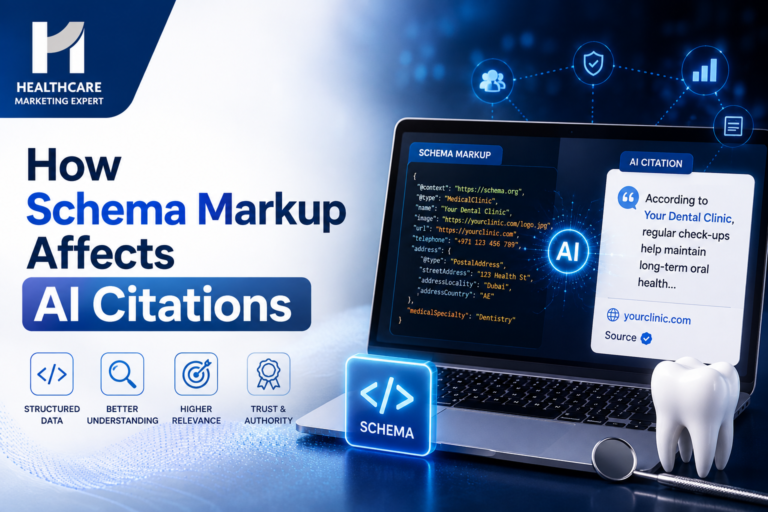
Structured data is a special type of code added to your website. It labels your content so machines can understand it clearly. For example, it can tell a search engine, “this is a blog article,” or “this is a healthcare service,” or “this is the author’s name.” This code is commonly called schema markup. Most experts recommend a format called JSON-LD, because it is simple and does not affect how your page looks to visitors.
How Structured Data Affects AI Citations
AI tools do not read a webpage the same way a person does. Instead, they scan the page for clear signals. Structured data gives these signals directly, instead of making the AI guess. As a result, AI tools can understand your page faster and with fewer errors.
However, structured data alone does not guarantee a citation. Research shows that pages with heavy schema markup do not always get quoted more than pages with little or no schema. So, schema is not a magic trick. Still, it plays an important supporting role.
For instance, separate research on AI models found that they extract facts more accurately when given clear, structured information, instead of plain text alone. This means schema acts like a form. It gives the AI clear fields to fill in, such as your business name, service type, author, and location. Because of this, the AI makes fewer mistakes when it describes your content.
In short, structured data does not force an AI tool to cite you. But it removes confusion. It also builds a stronger foundation of trust. And in AI search, trust and clarity matter just as much as good writing.
How AI Search Platforms Use Structured Data
Not every AI platform uses structured data the same way. Some platforms have openly confirmed it. Others have stayed quiet so far.
Google AI Overviews has confirmed that structured data gives websites a clear advantage in search results. Similarly, Microsoft Bing Copilot has confirmed that schema markup helps its AI systems understand web content better.
On the other hand, ChatGPT and Perplexity have not confirmed exactly how they use structured data yet. This does not mean schema is useless for these platforms. It simply means there is no public proof yet.
Even so, adding structured data remains a smart move. It costs little effort, and it may help more as these AI tools continue to grow and improve.
How to Add Structured Data to Your Website
Step 1: Choose the Right Schema Type
First, pick the schema type that matches your page. For example, use Organization schema for your homepage. Use Article schema for blog posts. Use Service schema for treatment or service pages. Choosing the right type helps AI tools understand your content from the very first scan.
Step 2: Create the Schema Code
Next, use a free tool to build your JSON-LD code. Most tools only ask you to fill in simple fields, such as your business name, description, and location. You do not need to write any code yourself.
Step 3: Validate Your Schema
After that, test your code before you publish it. This step checks for mistakes. It also shows which rich results your page may qualify for, such as star ratings or FAQ boxes.
Step 4: Add the Code to Your Website
Then, paste the JSON-LD code into the head section of your page. Most website builders make this simple with a plugin or a dedicated code field.
Step 5: Connect Your Entities Together
Finally, for stronger results, connect your schema pieces to each other. For example, link your author to your organization, and link your service page to your brand. This builds a small knowledge graph on your site. Because of this connection, AI tools can follow the relationships more easily, instead of reading each page in isolation.
Key Benefits of Structured Data for AI Search
Structured data offers several clear benefits for AI visibility:
- It helps AI tools understand your content clearly and quickly.
- It reduces confusion during AI extraction and summarizing.
- It builds stronger trust signals for your brand and authors.
- It improves your chances of appearing in Google AI Overviews and Bing Copilot.
- It supports traditional SEO rankings at the same time.
- It is low-cost, easy to maintain, and safe to implement.
Together, these benefits make structured data a smart long-term investment, even though it does not guarantee instant results. Most importantly, these benefits add up over time. A single page with clean schema helps a little. But a whole website with consistent, connected schema helps a lot. So, think of structured data as a habit, not a one-time task.
Common Mistakes That Hurt AI Citations
Many websites add structured data the wrong way. Because of this, they lose some of its benefits. Here are common mistakes to avoid.
First, some websites use the wrong schema type. For example, they use Article schema on a service page. This confuses AI tools instead of helping them. Second, some websites leave out key fields, such as author name or publish date. Without these fields, AI tools cannot build a clear picture of your content. Third, some websites never test their code. As a result, small errors go unnoticed for months.
Finally, many websites treat schema as a one-time task. However, structured data works best when it stays updated. So, review your schema every few months. Update it whenever your content, services, or team changes. This simple habit keeps your AI signals fresh and accurate.
Frequently Asked Questions
Does structured data guarantee AI citations?
No, it does not. Structured data does not guarantee citations. However, it helps AI tools understand and trust your content more easily.
Which AI platforms confirm they use structured data?
Google AI Overviews and Microsoft Bing Copilot have both confirmed that they use structured data. ChatGPT and Perplexity have not confirmed this publicly yet.
What is the easiest schema format to use?
JSON-LD is the easiest format to use. It sits quietly in your page header and does not change how your content looks to visitors.
Do I need coding skills to add schema markup?
No, you do not. Many free tools generate the code for you automatically. Most website platforms also let you paste the code in without any technical skill.
How is structured data different from regular website content?
Regular content is written for human readers. Structured data, on the other hand, is written for machines. It labels the same information in a clear, predictable format.
Can structured data help a healthcare business in Dubai?
Yes, it can. Structured data helps AI tools clearly understand your services, location, and expertise. As a result, it can improve your visibility in local AI search results across the UAE.
Should I add structured data even if I am not sure AI tools use it yet?
Yes, you should. Structured data is low-cost and easy to maintain. Even if a platform does not use it today, it likely will in the future. So, adding it now puts you ahead.
Grow Your AI Search Visibility With Healthcare Marketing Expert
Structured data is only one piece of the AI search puzzle. You also need strong content, clear entity signals, and a trusted brand presence across your website. This is exactly where Healthcare Marketing Expert comes in. Our team helps healthcare businesses build AI-ready websites from the ground up. We create clear, fact-based content. We add accurate schema markup to every key page. And we build the trust signals that AI systems look for before they cite a source. If you want your healthcare business to show up confidently in AI answers across Dubai and the UAE, our team is ready to help. Contact a Healthcare Marketing Expert today, and let us build your AI search strategy together.